ဘလော့

FotoFinder® with Moleanalyzer AI
The FotoFinder® Technology Detects Skin Cancer and Hair Abnormalities
Why choose FotoFinder® at VitalLife Skin & Aesthetic Center?
Equipped with physicians who specialize in the diagnosis of skin cancer and hair abnormalities (Precision Dermatologists), in addition to a team of surgeons and cancer physicians who work together to provide integrative treatment to patients (Holistic Care Team).
With the most recent updates to the intelligent program system to assist dermatologists in effectively screening for skin conditions (Artificial Intelligence systems for dermatologists), with two systems available including:
- Moleanalyzer AI accurately detects early skin cancer via Whole Body Mapping, which saves examination time for patients with multiple lesions.
- Trichoscale AI, which analyzes hair by measuring hair count, density, and evaluating the percentage and density of terminal hair and soft hair (Vellus Hair). In addition to assessing the percentage and density of hair growth (Anagen) and hair loss (Telogen) stages, while also being able to count the number of hair follicles (Hair Follicular). The system will capture photos and store data that can be compared and followed up on treatment results accurately, rapidly, and effectively, and the findings will be reported to patients immediately.
Photos will be captured by utilizing the latest Medicam 1000s Video Dermoscope, which employs Full HD CrystalView technology to generate clear, high-resolution, safe, and pain free images that can be used to detect skin cancer, hair and scalp lesions more accurately. This is the first of just a few places in Thailand to employ this technology for diagnostics.
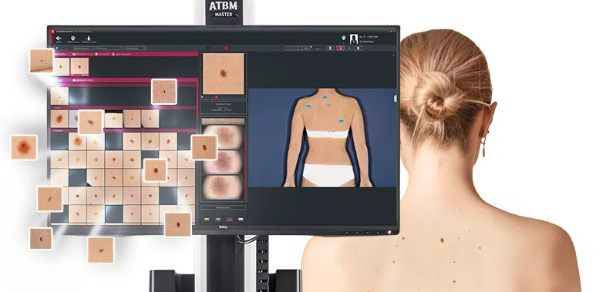
Accurate Skin Cancer Screening with Moleanalyzer AI SystemEarly detection with a greater than 95% possibility of successful treatment
FotoFinder® detects melanoma skin cancers formed by pigmented cells known as melanocytes, which are the cells that create melanin, or the dark pigment of the skin, hair, and eyes, as well as "Moles" on the body. Although the majority of moles do not progress to melanoma, melanoma often begins as an abnormal mole. Therefore, if cancer is detected at an early stage, there is a greater than 95% possibility of successful treatment.
Who should be screened for skin cancer with a FotoFinder®?
- Individuals with a family history of skin cancer.
- Individuals with a history of skin cancer with melanoma.
- Individuals who have a lot of moles.
- Individuals with large or irregularly shaped moles.
- Individuals who realize a mole has altered in appearance.
- Individuals who have a history of sun dermatitis.
- Individuals with fair or white skin.
Signs Indicating that a Mole is Abnormal:
- A sudden change in the size, color, form, texture of the mole or how it feels when touched.
- The mole is a mixture of different colors, the most of which are black.
- The border of the mole is abnormal with the skin around the mole taking on an unusual color.
- Surface abnormalities such as peeling, cracking, bleeding, open wounds, and discomfort that does not go away on their own, as well as the bulge appearing hard.
- Itchy and painful when touched.
Preparation Before the FotoFinder® Examination:
- Wear comfortable, simple-to-take-off shoes and clothing (the hospital will provide a change of clothes).
- Avoid applying body lotion, wearing makeup, and painting your nails.
- Use of tanning products should be avoided for at least a week before the photo session.
- If the patient's hair is long, the doctor will tie it up during the photoshoot.
- Doctors recommend that males with thick body hair in particular regions should shave the area to make the mole more visible
How often should one do the FotoFinder®?
Melanoma photoshooting should be done every 6-12 months or as recommended by a dermatologist. In addition, although the FotoFinder® may capture clear photos of skin abnormalities, a comprehensive skin examination by a specialist is still required.
Related Articles